
The Question Most People Never Ask About Their Retirement Plan
Most people are familiar with workplace retirement plans like 401(k)s and 403(b)s.
At a high level, they are simple: you contribute a portion of your paycheck, your employer may contribute as well, and over time those dollars are invested with the goal of supporting your future. They are designed to help individuals and families build long-term financial security.
But underneath that simplicity is something more complex and significant.
Those contributions are not sitting idle. They are being invested into global markets, into funds, and ultimately into real companies across the economy. Which means a workplace retirement plan is not just a savings tool. It is an investment engine. And that leads to a question most people have never been asked:
What is that engine actually fueling?
The Question Almost No One Is Asking
According to Triune advisor Geoff Huber, this conversation is nearly absent in the workplace retirement space.
* “The next time that I bring up faith-based or values-based investing with somebody… and they say, yeah, we were just talking about that with our advisor the other day, that’ll be the first time.”
That should give us pause.
We are talking about one of the largest pools of long-term capital in a person’s life, and yet most participants and many leaders have never been asked to consider what sits underneath it.
Not out of neglect. More often, out of assumption.
The Reality Beneath the Surface
A workplace retirement plan can feel abstract. Numbers on a screen. Percentages. Growth charts. But the underlying reality is very concrete.
As Geoff explains, “When you put that money in your account… you’re buying a proportional interest in several hundred, if not several thousand different companies.”
That means every contribution is not just saving. It is participation. Participation in businesses. In industries. In decisions being made far beyond your line of sight. So the question becomes unavoidable:
If you could clearly see everything you own, would you still be comfortable owning it?
This Is Not About Perfection. It Is About Stewardship.
Faith-based and values-based investing is often misunderstood. It is not about achieving a flawless portfolio. That does not exist.
Geoff is clear about that: “It’s not a perfect science… I can never say we’re going to be 100% perfect all the time.”
The real issue is not perfection. It is intentionality.
Ignoring the question entirely is a decision. Engaging it thoughtfully is stewardship.
For individuals of faith, or organizations with a defined mission, this becomes even more meaningful. Because alignment is not just a financial concept. It is a reflection of what you believe responsibility looks like.
For years, the industry operated on a simple assumption: If you care about values, you give up performance. That assumption shaped behavior. It discouraged questions. It kept many from even exploring alignment. But the data has moved.
As Geoff put it, “The generally accepted wisdom was… choose your values or performance… that’s no longer the case… there’s no discernible difference.”
No guarantees. No promises. But the premise has shifted. Which means we believe the real barrier today is no longer performance. It is awareness.
Why Most People Can’t Fix This on Their Own
Here is where the conversation gets more practical and more serious. Most employees cannot meaningfully change this on their own.
Why?
Because they are choosing from a pre-built menu.
And as Geoff explains, “If it isn’t done on the plan level, it’s virtually impossible to do on the employee level.”
This is a leadership issue.
The business owner.
The CFO.
The executive director.
The board.
The investment committee.
They are not just selecting funds. They are defining the options available to every employee and every family connected to that plan. That responsibility deserves more than autopilot.
The Quiet Cost Most Plans Ignore
While values often go unexamined, fees are frequently misunderstood. And the impact is not small.
Geoff described it plainly: high fees are like “starting the 100-meter dash 30 meters behind the rest of the field.”
That gap compounds over time. What makes this more concerning is how often it goes unchecked. Many plans are set up once and left alone. Meanwhile, the plan grows, and so do the dollars being paid in fees.
Without intentional oversight, overpayment can persist for years.
What High-Level Guidance Actually Looks Like
This is where experience matters. Not product selection. Not surface-level advice.
Real guidance starts by asking better questions. The kind most people have never been asked.
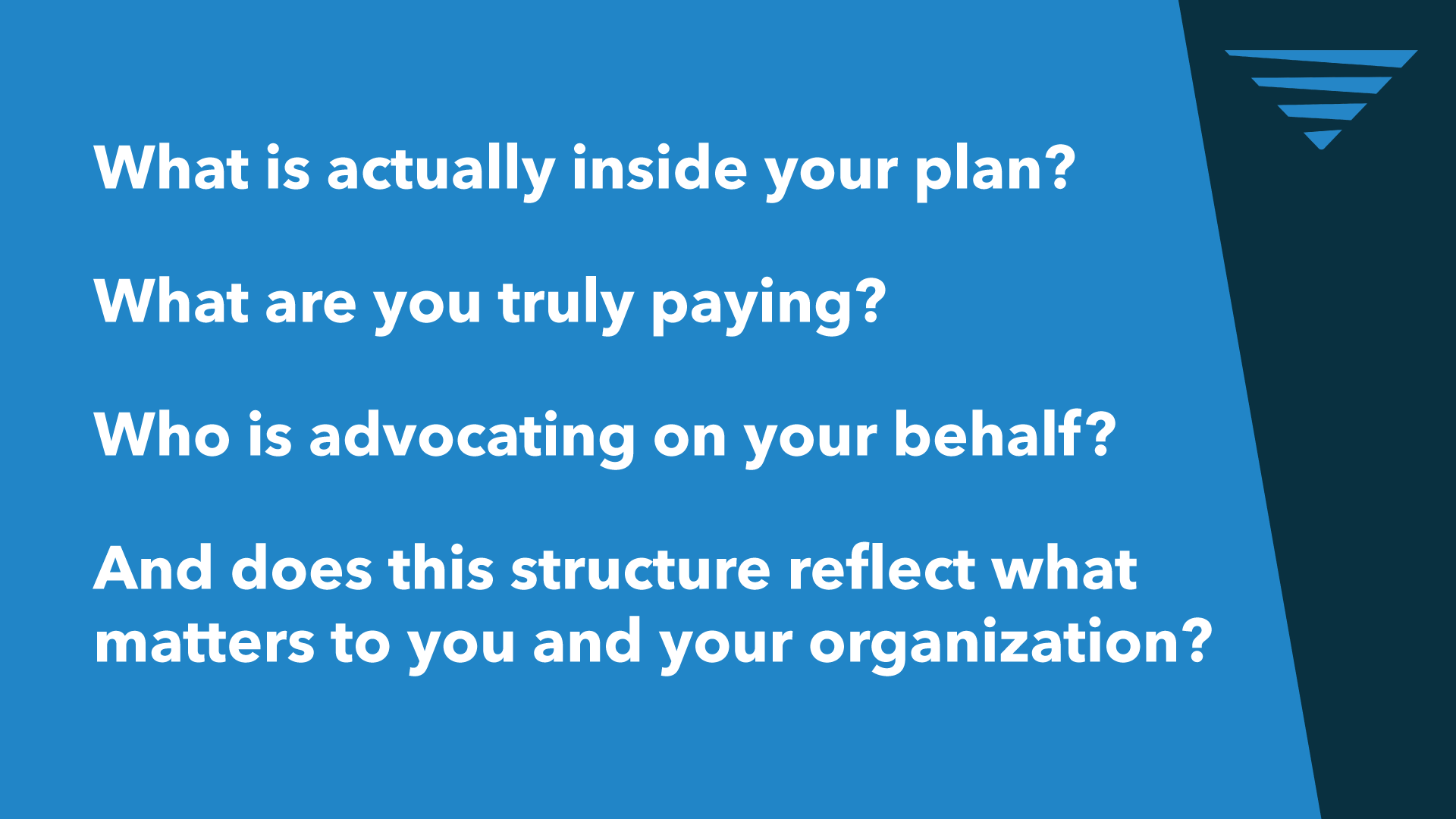
Geoff emphasized that many clients have never even considered these questions until they are asked.
From there, the role of a firm like Triune is not to force conclusions. It is to bring clarity, provide context, and help leaders and families make informed decisions.
Because alignment is rarely obvious. It has to be uncovered.
When Was the Last Time You Took a Real Look?
Most people can answer that question quickly. Or they cannot answer it at all.
Geoff described the typical responses:
Some say “never.”Some say “maybe 10 years ago.”A few say “recently.”
The reality is, the marketplace has changed. Investment options have evolved. Fee structures have compressed. The conversation around values has matured. But many plans have not kept up.
A Second Opinion Is a Structured Review Process.
At Triune, the S.O.S. (Second Opinion Service) provides a structured review.
Not to create friction. Not to replace relationships unnecessarily.
But to bring clarity to four critical areas:
Fees
Performance
Plan design
Alignment with values and goals
These are the same core areas fiduciaries are expected to monitor and evaluate on an ongoing basis. Informed decisions require visibility. And visibility rarely happens by accident.
This Is About More Than a Plan
Workplace retirement plans are often treated like administrative necessities.
They are not.
They are long-term financial engines.They are leadership decisions.They are expressions of care for the people who depend on them.
Your people are not participants. They are families, futures, and stories in progress. We help you steward that responsibility with clarity and care.
A More Honest Starting Point
If you have never asked what your plan truly reflects, you are not behind. You are simply at the beginning of a better conversation. Start there.
When was the last time you really looked under the surface?
And if the answer is unclear, a second opinion is not a risk.
It is, in our opinion, a wise next step.
This material is provided for informational and educational purposes only and should not be construed as investment advice or a recommendation to buy or sell any security. Views and opinions expressed are those of the author and may not reflect those of Triune. Information referenced in this material may include third-party sources believed to be reliable, but Triune does not guarantee the accuracy, completeness, or timeliness of such information and makes no representation regarding its suitability for any particular purpose.
*The views expressed are those of Geoff Huber, a representative of Triune. This statement is not a client testimonial. No compensation was provided for this statement.”